How often does Medicare pay for lab tests?
Medicare pays 100% for many blood tests, but only so often. Get one too early and you can be billed. Here is how often each one is covered, in plain English.
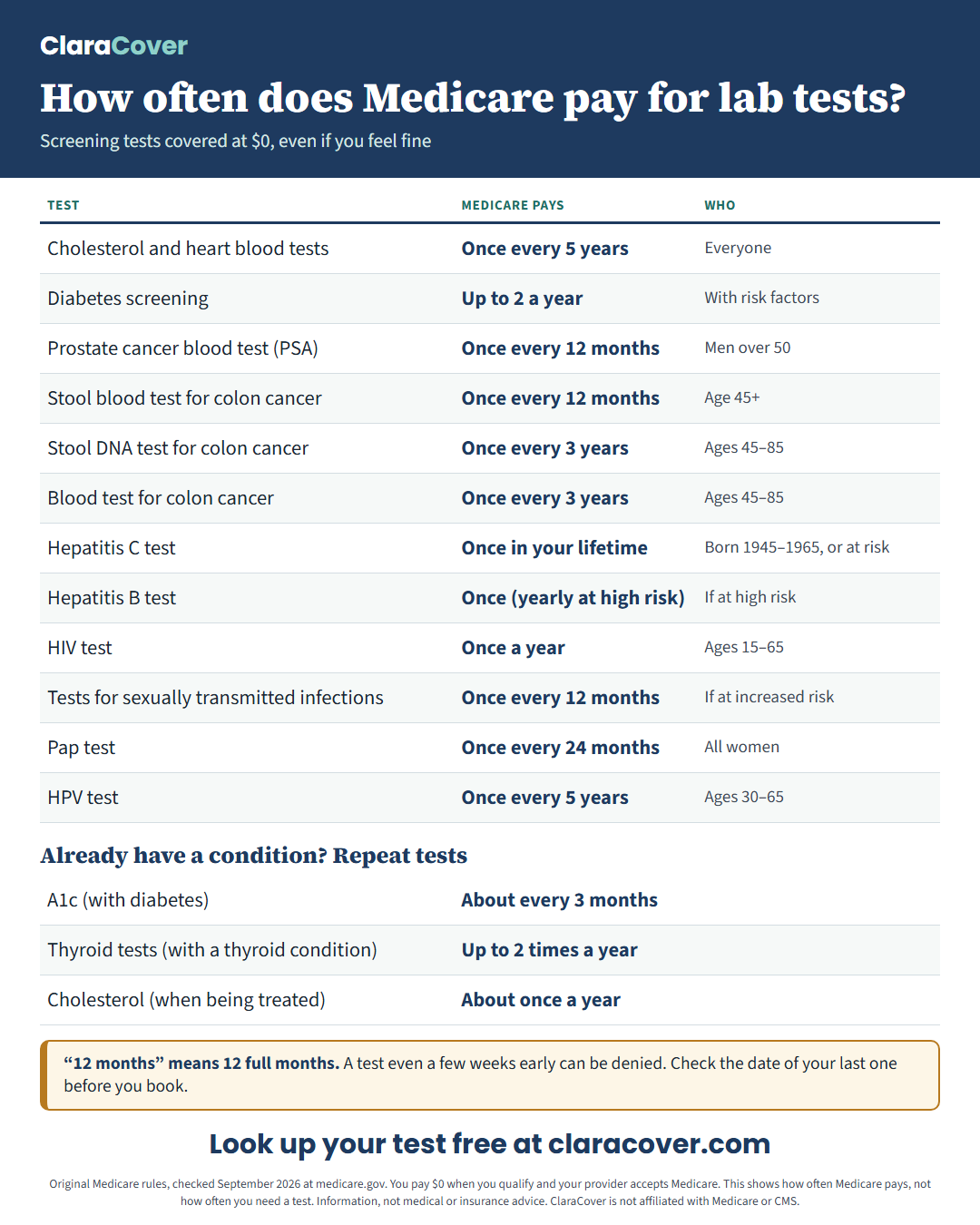
Free to print and share. Checked against Medicare’s published rules, September 2026.
Screening tests: covered even if you feel fine
These are checkups. You don’t need symptoms or a diagnosis. When you qualify and your provider accepts Medicare, you pay $0.
| Test | Medicare pays | Who qualifies |
|---|---|---|
| Cholesterol and heart blood tests Cholesterol, lipid, and triglyceride levels | Once every 5 years | Everyone on Medicare. No symptoms or risk factors needed. |
| Diabetes screening A blood sugar (glucose) test or an A1c test | Up to 2 a year | People with risk factors, such as high blood pressure, obesity, or a history of high blood sugar. |
| Prostate cancer blood test (PSA) | Once every 12 months | Men over 50, starting the day after the 50th birthday. |
| Stool blood test for colon cancer Fecal occult blood test, also called FIT | Once every 12 months | Age 45 and older. |
| Stool DNA test for colon cancer A mail-in kit that checks stool for DNA changes | Once every 3 years | Ages 45 to 85, at average risk, with no symptoms. |
| Blood test for colon cancer Blood-based biomarker test, where available | Once every 3 years | Ages 45 to 85, at average risk, with no symptoms. |
| Hepatitis C test | Once in your lifetime | Anyone born 1945 to 1965, or with a transfusion before 1992 or past injection drug use. Once a year if the risk is ongoing. |
| Hepatitis B test | Once (yearly at high risk) | People at high risk as Medicare defines it, or pregnant. Yearly only with continued high risk and no hepatitis B vaccine. |
| HIV test | Once a year | Ages 15 to 65. Younger or older if at increased risk. Up to 3 times during a pregnancy. |
| Tests for sexually transmitted infections Chlamydia, gonorrhea, syphilis, and hepatitis B | Once every 12 months | People at increased risk, and at certain times during pregnancy. |
| Pap test Cervical cancer screening | Once every 24 months | All women. Once every 12 months if at high risk. |
| HPV test Done along with a Pap test | Once every 5 years | Ages 30 to 65, with no HPV symptoms. |
Not blood work, but the same kind of rule
Three screenings people ask about most are not lab tests, so they are not in the chart, but each has its own schedule and its own page: bone density tests (once every 24 months, if you qualify), mammograms (once every 12 months from age 40), and colonoscopies (every 10 years at average risk, every 2 at high risk).
Repeat tests: when you already have a condition
These are not screenings. Medicare pays when your doctor orders them to manage a condition you have. The limits below are for someone whose condition is stable. When your doctor has a medical reason to test more often, Medicare can cover that too.
| Test | Medicare usually pays | Good to know |
|---|---|---|
| A1c, if you have diabetes | About every 3 months | More often when your diabetes is not under control or your treatment just changed. |
| Thyroid tests (TSH, T4), if you have a thyroid condition | Up to 2 times a year | More often when your dose has changed or you have new symptoms. |
| Cholesterol tests, if you are being treated for high cholesterol | About once a year | Up to 6 times in the first year of a new diet plan or medicine. |
| PT/INR, if you take a blood thinner like warfarin | As often as your care needs | There is no set number. Your doctor decides how often based on your results. |
| Vitamin D | Depends on your state | Regional rules, not national ones. Commonly 1 to 4 times a year, and only for certain diagnoses. |
The rule that surprises people: “12 months” means 12 full months
Labs check the date before Medicare does. A test that is even a few weeks early can be denied. You weren’t ineligible. You were early.
- Find the date of your last covered test. Your account at medicare.gov shows the claim, or ask your doctor’s office.
- Book at or after the full mark, not “about a year.”
- If the lab asks you to sign a payment pad anyway, ask them to print what you would owe first. Here is what to do at the lab.
How often will Medicare pay for routine blood work?
This is the question people ask most often, and the answer catches them out: for routine blood work, the answer isn’t a number — it’s never.
Medicare’s lab benefit pays for tests ordered to investigate or manage a medical problem. A test ordered because a year has gone by, with no condition, symptom or medication behind it, falls outside the benefit entirely. There is no frequency limit to hit, because it was never covered in the first place.
The chart above is about tests that are covered — either because Congress specifically authorized that screening, or because your doctor is managing something. Those have limits, and the limits are what this page exists to explain.
In practice most people on Medicare do have a condition or a medication that makes regular blood work medically necessary, so this bites less often than it sounds. It bites hardest at the annual wellness visit, where blood drawn on the day can arrive as a separate bill weeks later. Does Medicare cover blood work? The rule that decides it →
What this chart does and doesn’t tell you
- It shows how often Medicare will pay, not how often you need a test. That is between you and your doctor.
- “You pay $0” applies when you qualify and your provider accepts Medicare assignment. A doctor’s visit on the same day can have its own cost.
- This is Original Medicare. Medicare Advantage plans must cover the same screenings, but their rules for where to go can differ. Check with your plan.
- Many lab tests have no set schedule at all. They are covered whenever your doctor orders them for a medical reason. Look up a specific test.
Sources
Every row was checked against these pages on 2026-09-27. Rules change, so confirm with Medicare before you rely on a date.
- medicare.gov: Cardiovascular disease screenings
- medicare.gov: Diabetes screenings
- medicare.gov: Prostate cancer screenings
- medicare.gov: Fecal occult blood tests
- medicare.gov: Multi-target stool DNA tests
- medicare.gov: Blood-based biomarker tests
- medicare.gov: Hepatitis C virus infection screenings
- medicare.gov: Hepatitis B virus infection screenings
- medicare.gov: HIV screenings
- medicare.gov: Sexually transmitted infection screenings
- medicare.gov: Cervical and vaginal cancer screenings
- Medicare National Coverage Determination 190.21
- Medicare National Coverage Determination 190.22
- Medicare National Coverage Determination 190.23
- Medicare National Coverage Determination 190.17
- Regional Medicare coverage policies (they vary by state)
Holding a doctor’s order right now? We’ll look yours up. Free.
Send us the test codes and diagnosis codes from your order (no name, no Medicare number — just the codes and your state). Within 24 hours, you’ll get back a plain-English answer: likely covered or not, what Medicare pays, and what it would cost you either way.
We answer the first 10 requests each day, personally. This is a free service while we build the automated lookup tool.